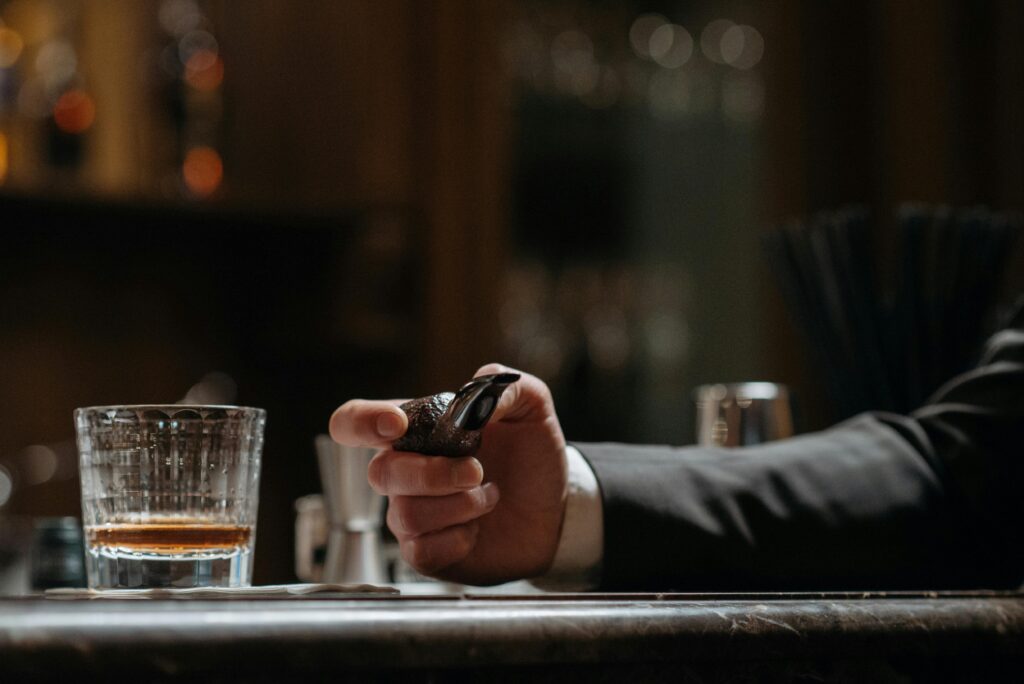
History is often written in the ink of treaties and the blood of battles, but if you look closer at the world’s most pivotal moments, you will often find a cloud of blue smoke and a glint of amber liquid in the background. For centuries, the pairing of a fine cigar and a premium whisky has been the “uniform” of world leaders, literary giants, and Hollywood rebels.
These were not just habits; they were extensions of their personalities. For these figures, the ritual of the leaf and the glass provided the clarity needed to lead nations, the inspiration to write masterpieces, and the charisma to captivate audiences. Here is a look at the historical legends who didn’t just enjoy whisky and cigars—they made them legendary.
1. Winston Churchill: The Patron Saint of the Pairing
It is impossible to discuss this topic without starting with Sir Winston Churchill. The British Prime Minister was rarely seen without his trademark “Romeo y Julieta” cigar. It is estimated that he smoked over 250,000 cigars in his lifetime, even having a specific size named after him—the “Churchill.”
However, the cigar was only half of the equation. Churchill was a devoted fan of Scotch whisky, often starting his day with a “whisky mouthwash” (a very weak mixture of Scotch and water) and continuing to enjoy it throughout his grueling wartime schedule. For Churchill, these luxuries were his “fuel.” They provided a sense of stability and defiance during Britain’s darkest hours. He once famously remarked, “I have taken more out of alcohol than alcohol has taken out of me.”
2. Mark Twain: The Wit and the “Bad” Cigar
The father of American literature, Mark Twain, was a man of immense humor and even greater tobacco consumption. Twain was known to smoke between 20 and 40 cigars a day. Interestingly, despite his wealth, Twain had a notorious reputation for smoking incredibly cheap, “stinky” cigars. He once claimed that he couldn’t smoke a “good” cigar because the taste was too distracting for his writing process.
Twain’s love for a good pour of Bourbon or Scotch was equally legendary. He often used the imagery of spirits in his writing to highlight the grit and reality of American life. For Twain, the ritual of smoking and drinking was an essential part of the creative process. He famously quipped, “If smoking is not allowed in Heaven, I shall not go,” a sentiment that resonates with many enthusiasts today.
3. Ernest Hemingway: Adventure in a Glass
Hemingway lived a life that was as bold and intense as the characters in his novels. Whether he was covering wars, hunting in Africa, or fishing in Cuba, a drink and a smoke were his constant companions.
While Hemingway is often associated with the Daiquiri, his true appreciation lay in the complexity of spirits that matched his rugged lifestyle. In Cuba, he became a fixture at the local lounges, appreciating the craftsmanship of hand-rolled cigars while sipping on whiskies that could stand up to the tropical heat. Hemingway’s “legend” helped bridge the gap between the refined European salon and the adventurous outdoor life, proving that a fine cigar and a glass of whisky belong just as much on a fishing boat as they do in a library.
4. Humphrey Bogart: The Noir Icon
In the golden age of Hollywood, Humphrey Bogart defined the “cool” factor of the whisky and cigar aesthetic. His roles in films like Casablanca and The Big Sleep cemented the image of the brooding, sophisticated man with a glass of Scotch in one hand and a smoldering cigar in the other.
Off-screen, Bogart was a true connoisseur. He was a founding member of the “Rat Pack” and took his spirits very seriously. His preference for high-quality Scotch and premium cigars wasn’t just a prop for the cameras; it was a lifestyle choice that influenced an entire generation of men to view these luxuries as symbols of integrity and quiet strength. Legend has it that his final words were, “I should never have switched from Scotch to Martinis.”
5. Frank Sinatra: The Chairman of the Board
If Bogart was the icon of the 40s, Frank Sinatra was the king of the 50s and 60s. Sinatra’s love for Jack Daniel’s was so profound that it is credited with helping the brand become the global powerhouse it is today. He referred to it as the “Nectar of the Gods” and was even buried with a flask of it.
Sinatra’s cigar of choice was often a high-end Monte Cristo. For “Ol’ Blue Eyes,” the cigar and the whisky were part of the performance. They represented the peak of American success—the idea that if you worked hard, you earned the right to enjoy the finest things the world had to offer. He brought an air of elegance to the ritual, making it synonymous with the tuxedo-clad glamour of Las Vegas.
The Legacy Continues
These figures didn’t just consume products; they curated an atmosphere. They understood that the true value of a fine whisky and a premium cigar lies in the pause they provide. In their high-stakes lives, these rituals were moments of peace, reflection, and connection.
Today, when we pour a glass of single malt or light a Maduro, we are participating in a tradition that spans generations. We are walking in the footsteps of giants who shaped the world with a cigar in their hand and a dram by their side.
Which historical figure’s style do you admire most? Are you a “Churchill” traditionalist or a “Sinatra” modernist?
Pro-Tip: If you want to drink like a legend, try a “Churchill” style pour—Johnnie Walker Red or Black Label with a splash of water. It’s a simple, classic way to enjoy a piece of history!
Leave a Reply